
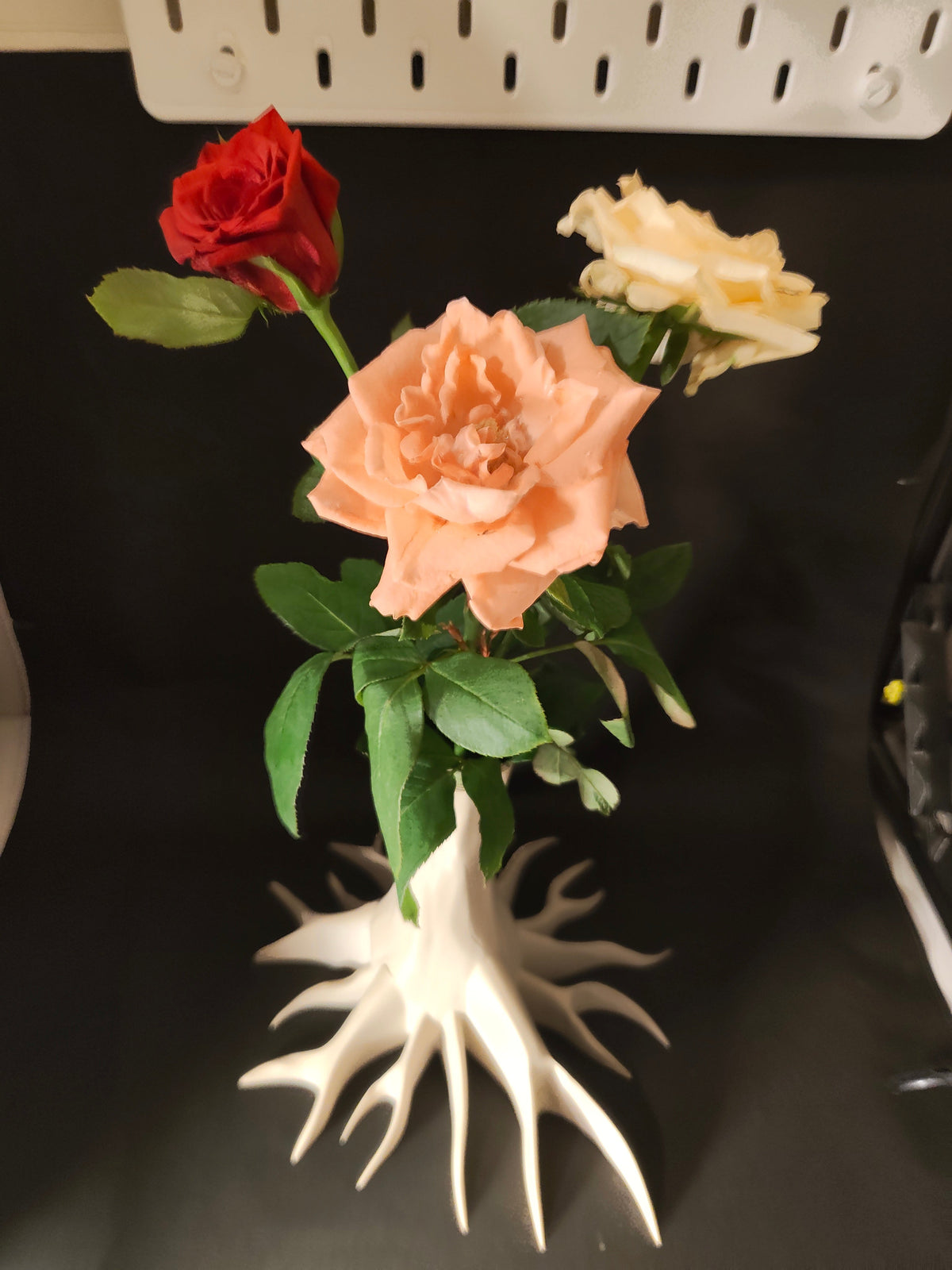
Many vases are designed to step back once the flowers arrive. Rootbound has a different presence. Its pale body narrows and twists before opening into root-like feet, giving the lower half of the arrangement its own movement. In the supplied photographs, the flowers are only one part of the composition.
The roots give it a point of view
The strongest detail is the transition from the upright body to the spreading base. It makes the object feel connected to the idea of a plant rather than simply acting as a container beside one. The pale finish also creates a clear contrast with the darker background in the close photograph.
The arrangement uses several flower colours, but the vase keeps the eye moving downwards as well as upwards. That is a useful quality on a shelf, where people often see an object at eye level rather than from above.

Give the base some room
The same root-like feet that make the design distinctive also ask for visual space. On a narrow or heavily filled shelf, small objects placed close to the base can make the composition feel tangled. We would keep the area immediately around the roots simple and let the vase occupy its own patch of surface.
There is no need for a large bouquet to match a sculptural vase. A lighter arrangement can make the silhouette easier to appreciate. If the flowers, frame and neighbouring ornaments all have strong shapes, remove one element and look again.
Our design take
Rootbound works best when it is treated as a sculpture that participates in the floral arrangement. Its character is the reason to choose it. Give that character enough room to remain visible, and the result can feel expressive without relying on a large number of stems or accessories.